
What Is ZR KVVP Fire Resistant Control Cable?
ZR KVVP fire resistant control cable is a specialized shielded control cable engineered with enhanced fire-resistant properties. The designation breaks down as follows:
- ZR: Stands for “Flame Retardant” (Zu Ran in Chinese), indicating the cable’s ability to resist flame propagation
- K: Represents control cable application
- V: Indicates polyvinyl chloride (PVC) insulation
- V: Denotes PVC sheathing
- P: Signifies copper wire braided shielding
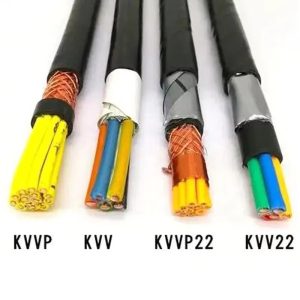
These cables feature a multi-layered construction typically consisting of:
- Stranded copper conductors for flexibility and conductivity
- Fire-retardant PVC insulation around each conductor
- Optional color coding for easy identification
- Overall copper wire braid shielding for EMI/RFI protection
- Special flame-retardant PVC outer sheath formulated to resist ignition and slow flame spread
ZR KVVP cables are specifically engineered for control and monitoring circuits in environments where fire safety is paramount, such as power plants, petrochemical facilities, high-rise buildings, transportation systems, and other critical infrastructure.
Technical Parameters and Specifications
Understanding the precise parameters of ZR KVVP cables ensures proper application and safety compliance:
Electrical Properties:
- Rated voltage: Typically 450/750V
- Conductor material: Annealed copper, stranded class 2 or 5
- Conductor cross-section: Commonly 0.5mm² to 10mm²
- Test voltage: Approximately 2500V for 5 minutes
Fire Performance Characteristics:
- Flame retardant rating: Complies with IEC 60332-1, GB/T 19666
- Smoke emission: Low smoke variant available (often designated as ZR-KVVP-LS)
- Halogen content: Standard versions contain halogens; halogen-free options also available
- Fire resistance duration: Typically maintains circuit integrity for 90+ minutes under fire conditions when properly installed
Physical Properties:
- Bending radius: Usually 6-8 times the cable diameter
- Operating temperature range: -15°C to +70°C (can vary by manufacturer)
- Installation temperature: Not below 0°C
- Shielding effectiveness: Typically 65-85 dB depending on braid coverage percentage
- Conductor resistance: Compliant with IEC 60228 or GB/T 3956 standards
Construction Specifications:
- Insulation thickness: Varies by conductor size, typically 0.6-1.0mm
- Sheath thickness: Generally 1.2-1.8mm depending on overall cable diameter
- Braid coverage: Usually 75-85% copper wire braid
- Available configurations: 2-core through 37-core, with various conductor arrangements
How ZR KVVP Differs from Other Control Cables
Understanding the distinctions between fire-resistant ZR KVVP cables and alternatives helps in making informed decisions:
ZR KVVP vs. Standard KVVP Cables
While standard KVVP cables provide electromagnetic shielding for control signals, they lack the specialized fire-retardant compounds found in ZR variants. Standard KVVP will burn and propagate flames when exposed to fire, whereas ZR KVVP significantly resists ignition and prevents flame spread. This critical difference makes ZR variants essential for safety circuits, emergency systems, and high-risk environments.
ZR KVVP vs. NH (Fire Resistant) Cables
NH (Nai Huo) cables are designed to maintain circuit integrity during fire conditions, often using mica tape insulation that continues functioning even when the outer materials burn away. ZR KVVP primarily prevents flame spread but may not maintain functionality as long as true fire-resistant (NH) cables. The ZR rating focuses on preventing fire propagation, making it ideal for limiting damage, while NH cables prioritize continued operation during fire events.
ZR KVVP vs. Low Smoke Zero Halogen (LSZH) Cables
Standard ZR KVVP cables typically contain halogenated compounds that enhance fire resistance but produce toxic smoke when burned. LSZH variants of fire-resistant cables eliminate this hazard, producing minimal smoke and no halogen gases during combustion. In confined spaces like tunnels, subways, or high-occupancy buildings, LSZH versions are often mandated despite their higher cost.
ZR KVVP vs. Armored Control Cables
Armored cables (like KVVP22) add mechanical protection through steel tape or wire armor but don’t inherently offer enhanced fire resistance. ZR KVVP can be manufactured with armor (resulting in ZR-KVVP22) for applications requiring both mechanical protection and fire resistance—a combination essential in industrial settings where both hazards exist simultaneously.
Frequently Asked Questions
Q: Can ZR KVVP cables be installed in conduit with other cable types?
A: Yes, ZR KVVP cables can be installed in the same conduit as other cables, but local electrical codes may require separation between power and control cables to prevent interference. Always maintain proper fire-stopping when penetrating fire-rated barriers.
Q: What’s the expected service life of ZR KVVP fire resistant control cable?
A: When properly installed and operated within specifications, these cables typically provide 25-30 years of reliable service. Actual lifespan depends on operating conditions, exposure to chemicals, UV radiation, and temperature extremes.
Q: Are there temperature limitations when installing ZR KVVP cables?
A: Yes—ZR KVVP cables should not be installed at temperatures below 0°C (32°F) as the insulation can become brittle and crack. The minimum bending radius must be maintained, and special installation procedures may be required in cold environments.
Q: How do I verify if a ZR KVVP cable meets fire safety standards?
A: Request test certificates from the manufacturer showing compliance with relevant standards such as IEC 60332 (flame propagation), IEC 61034 (smoke emission), and IEC 60754 (halogen acid gas emission). Reputable manufacturers provide these documents with each shipment.
Q: Can ZR KVVP cables be directly buried?
A: Standard ZR KVVP cables aren’t designed for direct burial. For underground applications, you’ll need an armored version (typically designated ZR-KVVP22 or ZR-KVVP32) with appropriate moisture protection and mechanical strength.
Purchase Recommendations
Selecting the right ZR KVVP fire resistant control cable requires careful consideration of your specific application:
For Industrial Control Systems
Choose standard ZR KVVP with appropriate core counts (typically 4-16 cores) for PLC connections, sensor networks, and control circuits in factories. Ensure the shielding coverage exceeds 80% for environments with significant electrical noise from motors or drives.
For Building Safety Systems
For fire alarm panels, emergency lighting control, and safety shutdown systems, consider ZR KVVP with enhanced fire ratings or even upgrade to NH (fire resistant) variants if circuit integrity during fire is essential. Low-smoke versions are strongly recommended in occupied buildings.
For Petrochemical and High-Risk Environments
Select halogen-free ZR KVVP (often designated as ZR-KVVP-LSZH or WDZ-KVVP) to minimize toxic smoke in confined spaces. These environments often require additional certifications like ATEX or IECEx for potentially explosive atmospheres.
Key Buying Considerations:
- Verify manufacturer certifications (ISO 9001, product-specific fire safety certifications)
- Request test reports for fire performance parameters
- Confirm compatibility with existing cable management systems
- Evaluate total cost of ownership—not just purchase price but installation ease and expected service life
- Consider future expansion needs when selecting core count and capacity