
What Are Low Voltage XLPE Insulated Unarmored Power Cables?
Low Voltage XLPE (Cross-Linked Polyethylene) Insulated Unarmored Power Cables are electrical conductors designed for power distribution at voltage levels typically up to 1kV (0.6/1kV rating). As the name suggests, these cables feature:
- XLPE insulation: A thermoset polymer created by cross-linking polyethylene molecules
- Unarmored construction: No metallic protective layer, making them lighter and more flexible
- PVC or PE outer sheath: Providing environmental protection without mechanical reinforcement
These cables typically consist of copper or aluminum conductors with XLPE insulation and a PVC or polyethylene outer sheath, designed specifically for applications where mechanical protection is provided by the installation environment.
Key Technical Specifications
Standard Compliance
Low Voltage XLPE cables adhere to several international standards ensuring quality and safety:
- IEC 60502-1
- IEC 60228
- IEC 60332
- BS 5467
- IS 1554 and IS 7098
Construction Details
- Conductor: Plain circular, compacted, or shaped stranded copper or aluminum
- Operating temperature: 90°C (rated)
- Voltage rating: 0.6/1kV (1.2kV maximum)
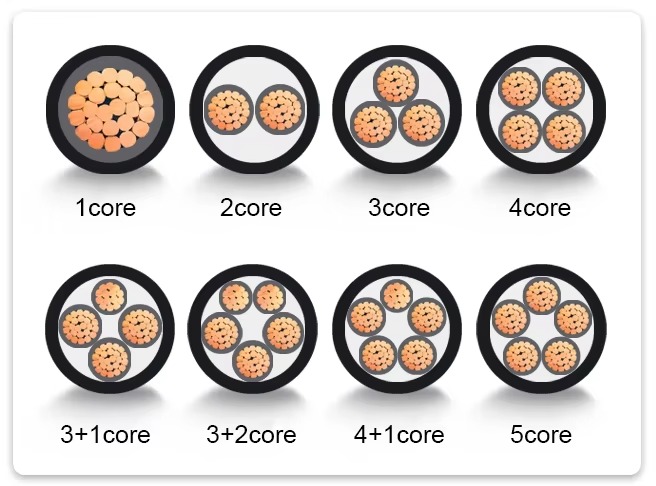
- Core configurations: 1, 2, 3, 4, 5, 3+1, 4+1, and 3+2 cores
- Cross-section range: 1.5mm² to 630mm²
Color Identification Standards
- 1 Core: Red or Black
- 2 Cores: Red, Black
- 3 Cores: Red, Yellow, Blue
- 4 Cores: Red, Yellow, Blue, Black
- 5 Cores: Red, Yellow, Blue, Black, Green
- Above 5 Cores: Black with white numerals
Advantages of XLPE Insulated Unarmored Cables
Superior Electrical Properties
XLPE insulation provides exceptional dielectric strength, allowing for efficient power transmission with minimal losses. The cross-linked molecular structure offers consistent performance even under varying load conditions.
Thermal Performance
With a rated operating temperature of 90°C (compared to 70°C for PVC-insulated cables), XLPE cables can handle higher current loads and short-circuit temperatures, enhancing overall system reliability.
Environmental Resistance
XLPE insulation demonstrates excellent resistance to:
- Moisture
- Chemical corrosion
- UV radiation (with appropriate sheathing)
- Temperature fluctuations
Installation Benefits
The unarmored design offers significant advantages:
- Lighter weight for easier handling
- Greater flexibility for routing through complex pathways
- Reduced installation time and labor costs
- No need for specialized tools for cutting or termination
Cost Efficiency
Without the armored layer, these cables represent a more economical solution for protected installations, offering an optimal balance between performance and budget constraints.
Common Applications
Low Voltage XLPE Insulated Unarmored Power Cables excel in environments where mechanical protection is not a primary concern:
- Indoor installations: Building wiring systems, electrical panels, and distribution boards
- Protected conduits: When installed within protective tubing or ducting systems
- Cable trays and ladders: In industrial settings with controlled environments
- Tunnel systems: Where external damage risks are minimal
- Fixed installations on brackets: In controlled industrial environments
- Buried applications: Where soil conditions are benign and no significant mechanical stress is expected
Installation Guidelines
Proper installation is crucial for maximizing the performance and lifespan of unarmored XLPE cables:
- Bending radius: Maintain minimum bending radius of 12× cable diameter during installation
- Pulling tension: Limit pulling tension to avoid conductor damage
- Environmental considerations: Ensure installations avoid areas with:
- Potential rodent damage
- Sharp objects that could puncture the sheath
- Excessive moisture without proper drainage
- Chemical exposure beyond cable specifications
- Termination: Use appropriate glands and connectors designed specifically for XLPE insulation
- Support spacing: Follow manufacturer recommendations for support intervals to prevent excessive sagging
XLPE vs. Alternative Insulation Materials
| Feature | XLPE | PVC | EPR |
|---|---|---|---|
| Max Operating Temp | 90°C | 70°C | 90°C |
| Short Circuit Rating | Excellent | Good | Very Good |
| Moisture Resistance | Excellent | Good | Excellent |
| Chemical Resistance | Very Good | Fair | Excellent |
| Cost | Moderate | Low | High |
| Flexibility | Good | Very Good | Excellent |
XLPE insulation strikes an optimal balance between performance characteristics and cost-effectiveness, making it the preferred choice for most low-voltage applications.
Common Types & Designations
Several standard designations exist for low voltage XLPE unarmored cables:
- YJV: Copper conductor, XLPE insulated, PVC sheathed
- YJLV: Aluminum conductor, XLPE insulated, PVC sheathed
- YJY: Copper conductor, XLPE insulated, PE sheathed
- YJLY: Aluminum conductor, XLPE insulated, PE sheathed
Each designation indicates specific conductor material, insulation type, and sheathing material to help engineers select the appropriate cable for their application requirements.
Frequently Asked Questions
Can XLPE unarmored cables be directly buried?
While possible in some installations, direct burial of unarmored cables is generally not recommended unless the soil conditions are ideal and there’s no risk of mechanical damage. For direct burial applications, armored variants (like YJV22) provide better protection.
What’s the expected lifespan of XLPE insulated cables?
When properly installed and operated within specifications, XLPE insulated cables typically have a service life exceeding 30 years. Their cross-linked molecular structure provides excellent resistance to thermal aging.
How do I determine the correct cable size for my application?
Cable sizing depends on several factors including:
- Load current requirements
- Ambient temperature
- Installation method
- Allowable voltage drop
- Short circuit withstand capability Always consult local electrical codes and consider using cable sizing software or professional engineering advice.
Are XLPE cables suitable for fire-sensitive environments?
Standard XLPE cables aren’t inherently fire-resistant. For fire-sensitive applications, look for variants with LSZH (Low Smoke Zero Halogen) sheathing or fire-retardant compounds specifically designed for these environments.
Can XLPE cables be installed in wet locations?
Yes, XLPE insulation has excellent moisture resistance properties. However, for constant immersion or extremely wet environments, specialized cable constructions with enhanced water-blocking features are recommended.